
Home / Medical Dermatology / Skin Cancer Screening
Full-Body Skin Cancer Screenings in Jacksonville
A full-body skin cancer screening is a head-to-toe skin exam focused on finding skin cancer and precancerous sun damage as early as possible. In Florida’s year-round sun, regular screenings are one of the most important things you can do for your skin. At Jacksonville Dermatology & Cosmetic Surgery, screenings are performed by our experienced providers under the medical direction of Dr. Brandon T. Beal, a double board-certified, fellowship-trained dermatologist.

Double board-certified
Dr. Beal holds board certification in dermatology and Mohs micrographic surgery.
Fellowship-trained
Advanced training under Drs. Zitelli and Brodland.
Physician-owned
Independently owned small business, never a corporate chain.
Southpoint, Jacksonville
Off I-95 at Southpoint, minutes from most of Jacksonville and the beaches.
Why Skin Cancer Screenings Matter in Florida
Skin cancer is the most common cancer in the United States. More than 5 million skin cancers are treated each year, and about 1 in 5 Americans will develop skin cancer by age 70. The cause is well understood: ultraviolet (UV) radiation from the sun damages the DNA in skin cells, and over time some of those cells begin to grow abnormally. More than 80 percent of non-melanoma skin cancers occur on the head and neck, the areas most constantly exposed to the sun.
Living in Jacksonville raises the stakes. Florida’s UV index stays high nearly year-round, and days on the water, at the beach, or on the golf course add up over a lifetime. The good news is that skin cancer is largely preventable through sun protection, and when it is found early, it is often very treatable. That is exactly what a full-body screening is for: catching changes while they are still small.
What We Screen For
During a full-body screening, your provider examines your skin from head to toe for anything new, changing, or unusual. The three most common skin cancers are basal cell carcinoma, squamous cell carcinoma, and melanoma. Most people have heard of melanoma because it is the deadliest, but basal cell and squamous cell carcinomas are far more common.
We also look for precancerous sun damage. In Jacksonville’s climate, actinic keratosis, the rough, scaly patches caused by long-term sun exposure, is one of the most common findings at a skin exam. Catching these lesions matters because they can progress toward squamous cell carcinoma if left alone.
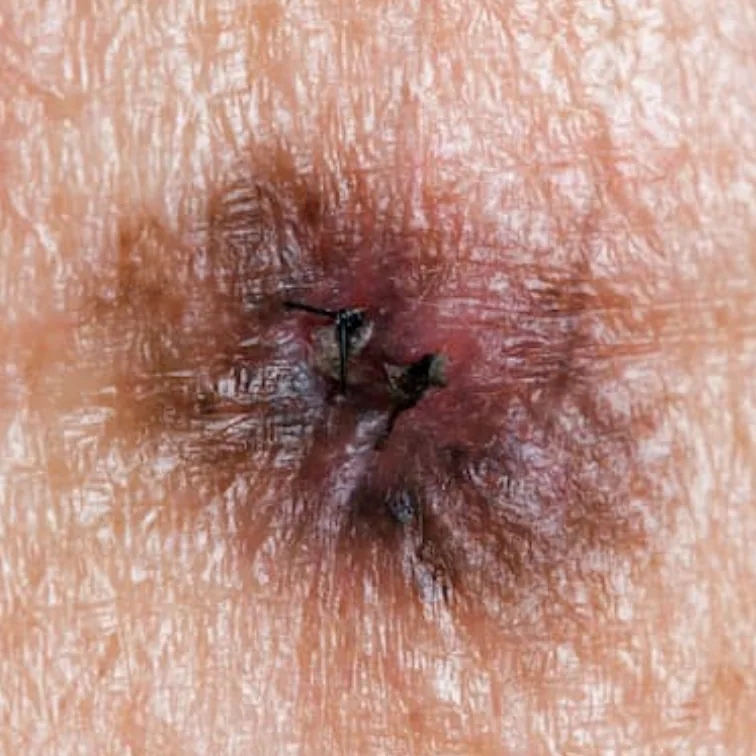
Basal cell carcinoma
The most common skin cancer. It often appears as a pearly bump, a pink patch, or a sore that heals and reopens, most frequently on sun-exposed skin like the face, ears, and neck. It grows slowly and rarely spreads, but it can be locally destructive if ignored.
Squamous cell carcinoma
The second most common skin cancer, often appearing as a firm red bump, a scaly patch, or a sore that doesn’t heal. It is more likely than basal cell carcinoma to grow deeper or spread if untreated, which is why early detection matters.
Melanoma
The most serious common skin cancer. It usually shows up as a new mole or a change in an existing one. The ABCDE rule is a helpful memory aid for warning signs:
- Asymmetry: one half doesn’t match the other
- Border: edges are irregular, ragged, or blurred
- Color: multiple colors or uneven shading
- Diameter: larger than a pencil eraser (about 6mm), though melanomas can be smaller
- Evolving: changing in size, shape, color, or symptoms like itching or bleeding
Precancerous sun damage (actinic keratosis)
Rough, scaly, sometimes tender patches on sun-exposed skin. When a screening finds actinic keratosis, it can often be treated right here in our Jacksonville office with photodynamic therapy (blue light), a non-invasive light treatment for precancerous lesions.
What Happens If We Find Something
Most screenings end with reassurance. When a spot does need attention, your provider will explain what they see, what it means, and exactly what the next step is. Precancerous lesions like actinic keratosis can often be treated in our office with photodynamic therapy. Moles that need a closer look are handled through non-surgical mole evaluation and removal.
Our Jacksonville office focuses on screening, evaluation, and medical dermatology; we do not perform surgical procedures at this location. If a finding calls for surgical treatment, your provider will walk you through the diagnosis and help coordinate the right care, so nothing falls through the cracks. And for brown spots or sun damage that turn out to be cosmetic rather than medical, M22 IPL is often the right tool.
Your Screening Visit
1
Before
You’ll change into a gown so your provider can examine your skin head to toe. Mention any spots that are new, changing, itching, or bleeding, and anything you’ve been keeping an eye on.
2
During
Your provider checks your skin from head to toe, including easy-to-miss areas like the scalp, ears, back, and between the toes, and may use a dermatoscope, a handheld magnifier, for a closer look at any spot. The exam is quick and involves no needles or incisions.
3
After
Your provider reviews what they found and what it means. Most visits end with peace of mind and a recommended screening interval. If anything needs attention, you’ll leave knowing exactly what happens next.
Who Should Be Screened, and How Often?
Anyone can develop skin cancer, but your risk is higher with fair skin, blond or red hair, blue eyes, a history of sunburns or indoor tanning, heavy cumulative sun exposure, atypical moles, or a family history of skin cancer. If you’ve already had one skin cancer, your chance of developing another within five years is roughly 50 percent, which makes ongoing screening especially important.
The American Academy of Dermatology recommends the following screening intervals:
- Annual screening for patients without a history of skin cancer, starting at 65
- Annual screening for patients with a history of basal cell carcinoma
- Annual screening for patients with a history of squamous cell carcinoma
- Annual or, in many cases, more frequent screening for patients with a history of melanoma
In Florida, cumulative sun exposure adds up faster than in most of the country, so many patients choose to start regular screenings earlier. Talk to your provider about the interval that makes sense for your skin and your risk factors.
Screening recommendations vary. Your provider will recommend an interval based on your skin, history, and individual risk factors.
Protecting Your Skin Between Screenings
- Use a broad-spectrum (UVA + UVB) sunscreen with SPF 30 or higher every day. On cloudy days, about 80 percent of UV radiation still reaches you, and one long-term study found that regular sunscreen use cut melanoma risk roughly in half.
- Wear sun-protective clothing, UV-blocking sunglasses, and a wide-brimmed hat.
- Seek shade or create your own under a tree, umbrella, or cabana, especially midday.
- Never use tanning beds or sunlamps. The FDA classifies them as carcinogenic.
- Do a monthly self-skin exam. Check everywhere: your back, the backs of your legs, your scalp, the bottoms of your feet, and between your toes. Use a hand mirror with a full-length mirror, and ask your hairdresser or a friend to look at your scalp.
How to photograph a spot for your provider
Photos taken over time are a simple, powerful record of whether a mole is changing. Use a well-lit room, ideally with natural light. Take a wide photo of the whole area first, then a close-up from about one foot away; a common mistake is getting the camera too close. Zoom in afterward to make sure both photos are sharp, and retake anything blurry.
Schedule a Skin Cancer Screening in Jacksonville
If you haven’t had a full-body skin exam recently, or you’ve never had one, now is the right time to start. We welcome patients from across the Jacksonville area, including Ponte Vedra and Jacksonville Beach, at our office at 6817 Southpoint Pkwy, Suite 101. Send a request through our contact page, or call (904) 420-7372 to speak with our team. You can also review our pricing page.
Common questions
Skin Cancer Screening FAQs.
How often should I get a skin cancer screening?
The American Academy of Dermatology recommends annual screening starting at 65 for patients with no history of skin cancer, annual screening for anyone with a history of basal cell or squamous cell carcinoma, and annual or more frequent screening after melanoma. Many Florida patients start regular screenings earlier given the year-round sun exposure. Your provider will recommend an interval based on your individual risk.
What happens during a full-body skin exam?
You change into a gown and your provider examines your skin from head to toe, including areas that are easy to miss like the scalp, back, and between the toes. The exam is quick, non-invasive, and involves no needles or incisions. Any spot that needs a closer look gets one before you leave.
Do you treat skin cancer at your Jacksonville office?
Our Jacksonville office focuses on screening, evaluation, and medical dermatology, and we do not perform surgical procedures, including Mohs surgery, at this location. Precancerous lesions like actinic keratosis can often be treated in our office with photodynamic therapy. If a screening finds something that needs surgical treatment, your provider will explain the diagnosis and help coordinate the right care.
Does insurance cover skin cancer screenings?
A skin cancer screening is a medical visit, and many insurance plans provide coverage; the specifics depend on your plan. Our team can help you understand what to expect before your visit, and current information is on our pricing page.
What should I watch for between screenings?
Do a monthly self-exam and watch for anything new, changing, or unusual: a mole that grows or changes color, a sore that doesn’t heal, or a rough patch that keeps coming back. The ABCDE rule (asymmetry, border, color, diameter, evolving) is a useful guide for moles. If something concerns you, don’t wait for your next scheduled screening, just call us.
Early detection starts here.
Full-body skin cancer screenings for early detection of skin cancer and precancerous sun damage. Physician-owned and independent, in Jacksonville.