
Not all brown spots are alike. Learn when a raised spot warrants a medical skin check and what your treatment options are.
Brown spots on the skin are incredibly common — and most are completely harmless. But common doesn’t mean every spot should be ignored. Some stay stable for decades. Others change in ways that deserve a closer look. Knowing which is which starts with understanding what you’re looking at.
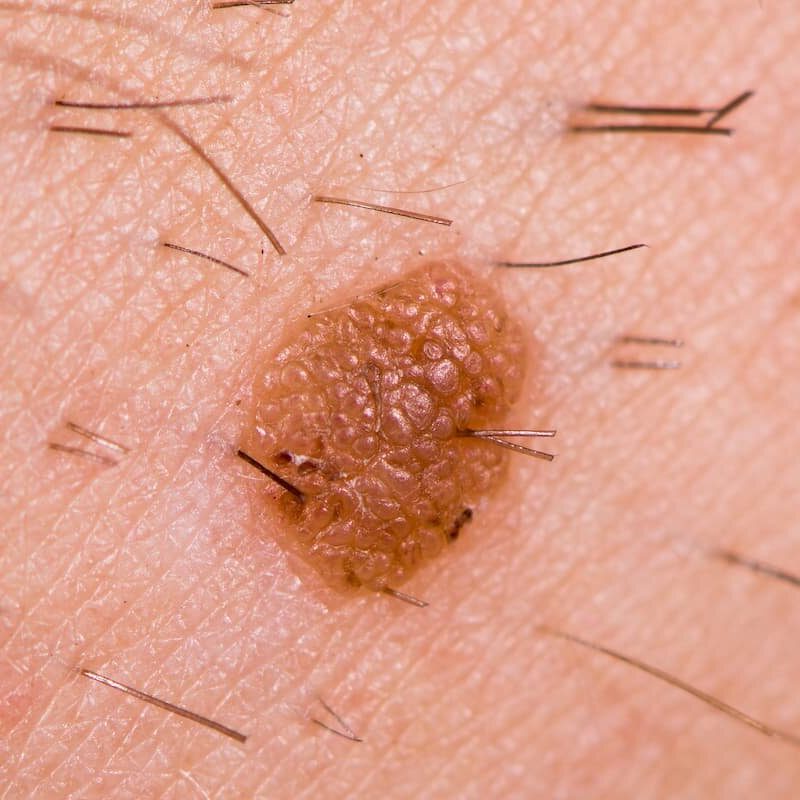
What Causes Raised Brown Spots?
Most brown spots develop when an area of skin produces more melanin than the surrounding tissue. The usual drivers are sun exposure, age, and genetics. Jacksonville’s year-round UV environment accelerates this process — cumulative sun exposure is the single biggest contributor to spots appearing on the face, hands, shoulders, and chest over time.
The most common types of patients ask about include:
- Solar lentigines (age spots / “liver spots”) — Flat or slightly raised spots that develop from years of sun exposure. Despite the nickname, they have nothing to do with the liver.
- Seborrheic keratoses — Waxy, rough-textured growths that look “stuck on” the skin. Very common in adults over 40. Benign, but sometimes difficult to distinguish from other lesions without evaluation.
- Common moles (melanocytic nevi) — Clusters of pigment cells that can be flat or raised. Most are stable and harmless throughout a person’s life.
- Actinic keratoses — Rough, scaly patches that may appear pink, tan, or brown. Unlike the others, these are considered precancerous and should be evaluated promptly.
When Should a Spot Be Evaluated?
This is the most important question. The ABCDEs are a widely used framework for identifying features that warrant professional attention:
- A — Asymmetry: One half doesn’t match the other
- B — Border: Ragged, notched, or blurred edges
- C — Color: Multiple shades within a single spot
- D — Diameter: Larger than a pencil eraser (though smaller spots can still be concerning)
- E — Evolving: Any change in size, shape, color, or texture — or a spot that bleeds, itches, or crusts
Beyond the ABCDEs, schedule an evaluation if a spot is new and appeared suddenly, if it looks noticeably different from your other spots, or if you simply haven’t had a full-body skin exam in the past year or more. For anyone who has spent significant time in the Florida sun — especially without consistent sun protection — routine annual skin checks are a reasonable standard of care.
What Happens at a Skin Check?
A full-body skin examination is a thorough visual review of your skin from head to toe. Our dermatology team uses a dermatoscope — a specialized magnifying instrument — to evaluate individual spots more closely when needed. If anything warrants further assessment, a small in-office biopsy can be performed to get a definitive answer. Most patients find the process straightforward and leave with clear information about what they’re dealing with.
What If a Spot Is Confirmed Benign?
Once a spot has been professionally evaluated and cleared, some patients choose to address it for cosmetic reasons. Depending on the type of pigmentation and your skin, options may include topical treatments, chemical peels, or cryotherapy. A consultation is required to determine what’s appropriate for your individual skin and goals.
Results vary. Treatment plans are individualized. A consultation is required to determine candidacy.
Schedule a Skin Check in Jacksonville
If you’ve been watching a spot and wondering whether it’s time, it probably is. Our team at Jacksonville Dermatology & Cosmetic Surgery sees patients throughout Jacksonville, Ponte Vedra, St. Johns, and surrounding communities.
Call (904) 420-7372 or request a consultation by filling out our online contact form.
GET IN TOUCH